Navigating the Pre-Packaged Salad Aisle
Is something as simple as making a salad, becoming too time consuming a thing. Do you find yourself ordering a salad from a drive thru, or grabbing a pre-packaged one at the grocery all too often? Busy people often find themselves opening up some low calorie, nutrient deficient, shrink wrapped and pre-packaged salad for their lunch at work. You’re trying to eat healthy, but convenience often wins.
Are All Salads Healthy?
These types of salads are marketed as healthy. They may brandish labels with the words lean, low-fat, organic, or superfoods on them. Not only are most of these salads actually unhealthy, they are for the most part, not even vegan.
Few Vegan Options at the Store
Picking the chicken or cheese off a salad to make it edible, makes most vegans cringe. Yet it’s all too common a practice, faced with the little choices they have at the store. So why are so many vegans forced to self-modify their to-go salad or simply go hungry?
Prepackaged No Thank You
Nobody wants to have a daily ritual which involves dissecting your lunch, separating what is edible from the non-edible. Then there is the dressing. So the pain does not end there. Prepackaged and to-go salads often come with non-vegan dressings. Many of which either have dairy, or are loaded in sugar. Cheaper inflammatory oils such as soy, canola, or vegetable are often used in these too. Can vegans ever win?

Plant Powered Protein
Vegans get their protein from plants. Vegan protein sources are vast, with legumes ranking high in the protein department. Tofu is a soy product many vegans enjoy. Most prepackaged salads however, lack a vegan protein option. They usually will have either meat, or cheeses, with just a few legumes thrown in for variety, if any. This is utterly frustrating for vegans, just wanting a simple, nutritionally balanced, and healthy salad.
More Salad Less Obesity
The majority of people, 42% of whom are obese, enjoy these kinds of salads, leaving the vegan minority with few options. (NIH) However, there has been an increase of people switching to vegan diets, of 600% in the last few years. (NIH) So although companies are beginning to take notice, and provide more salad options that are either plant based, or fully vegan, they have a long way to go.
A Garden of Opportunities
Garden Salads are commonly available just about everywhere. The problem with them is that they generally lack good vegan proteins, or calories for that matter. Even the lettuce used in grocery stores for to-go salads, or ones you might pick up in a drive through most likely are made with nutrient deficient greens, such as iceberg lettuce.
Nutrition is Key
Nobody wants to be a nutrient deficient vegan. Fortunately there are quick and easy solutions, so that you can enjoy a delicious, healthy vegan salad everyday, with little to no effort. If your skeptical, read on, and I will show you how.
Healthy Vegan Salad 101
But you may be wondering, if it’s so easy to make a great tasting salad, then how come vegan restaurants are able to charge so much for their salads?
Is Making a Salad Really That Simple?
It is easy to make a nutritious vegan salad utilizing whole foods, which are unprocessed. There are a couple of shortcuts along the way too. The best part is the convenience factor. It does not even take that much time to accomplish this. You can have an entire week of salads prepared in no time.

Going Green
Starting with greens, from romaine, to mixed baby greens, spinach, or kale, the base for the salad sets the tone for the entire meal. The greens either pack a nutrient dense punch, or leave you starving. When you make the salad, you’re in control of your own health, and lunch. One of my shortcuts is to use pre-washed bags of baby kale or spring greens from the grocery.
Shopping Your Salad Ingredients
When I am shopping for my salad ingredients I prefer the farmers market, or a store like Trader Joes. Shopping at smaller grocery stores saves me time. Their prices are competitive, and that saves me money. My last consideration, but certainly not least, is the quality of the ingredients. The farmers market is always my pick for delicious seasonal veggies, and fruits.
More Ways to Save
I love the surprises I find in a place like Grocery Outlet, where they always seem to have a bargain on produce, along with great vegan products. Costco can’t be beat for their mega sized packages of organic pre washed greens, for big salads. The time to navigate around the store for a few items deters me from going there that frequently.
More for Less
You can make a whole lot more salad for less money when you make it yourself. An organic garden salad, or basic vegan kale caesar can be made for less than a dollar. For a larger salad, balanced in nutrition, with protein, and good carbs, you’re usually looking at around $3 or less. Compare that to the $8-15 you would pay for a larger vegan salad in a grocery or restaurant.
Good Proteins
Some examples of good vegan proteins are legumes, tofu, or seitan, which is made from wheat gluten. These powerhouses will help build a salad, which will not only help you feel more satisfied, you will have more lasting energy all day long. If your plant is based, add any healthy alternative protein that works for you.

Good Fats
When choosing your base for your salad dressing you may be overwhelmed with all the different oils available. You need not use fat in your dressing itself. Using good fats in your salad, not only helps absorb certain nutrients better, it’s important for brain health. Everything from tahini, to avocados, to walnuts, and sprouted pumpkin seeds are options for adding good fats to your salad.
Feed Your Brain
According to Dr. Georgia Ede, “ the brain (and indeed, every cell in the human body) requires cholesterol to function properly. Although the brain represents only 2% of total body weight, it contains 20% of the body’s cholesterol. Cholesterol is required for brain cell membrane structure and function, and is a vital component of myelin (brain cell insulation).” So on a vegan diet, you will want to give your brain what it needs. Read more about what vegan brains need to stay healthy here.
Don’t Forget Good Carbs
Salads can have carbs too. Everything from brown rice, to buckwheat, to fresh corn, or quinoa, really bulk up your salad, making it a full meal. Carbs like potatoes, and rice are not always traditionally included in salads, but they not only bulk them up, they provide you with lots more energy to conquer the day.
Rice Based Salads
You can even make rice the main ingredient in your salad. One of my favorite cold salads is a wild rice salad, with cranberries, currants, apples, green onion, cucumbers, pecans, all tossed in a slightly sweet curried dressing.
Put Leftovers to Work
I usually have leftovers of some kind lying around. Cooked white rice, brown rice, wild rice, buckwheat, quinoa, roast potatoes, roast sweet potatoes, roasted root vegetables, quinoa, broccoli, cooked chilled green peas, and all types of legumes, such as chickpeas are all great accompaniments in your salad.

Tip: Try roasting your leftover chickpeas on a baking sheet at 400 degrees with a spray of coconut oil, along with salt and pepper. In about 30 minutes, be prepared to enjoy a crunchy, yet healthy, delicious snack, which doubles as a salad topping.
Zero Waste
The first thing I do is assess my salad making needs before a trip to the store. I check what needs to be used up first. I will build a meal around that ingredient, before going out and buying more vegetables.
Take Inventory
I always keep a supply of veggies in my fridge every week, and err on the side of a little too much. Today I have heirloom tomatoes, carrots, onion, bell pepper, spring greens, sliced mushrooms, and cucumbers on hand for my salad making adventures.
Store Vegetables Optimally
Most vegetables store well in the fridge, but some are best stored on the counter, or in a cool dark place. Potatoes need to stay out of the light. Bananas tend to attract flies, if not covered with a screen, plastic, or paper bag.
Wash or Wait?
It’s actually best to store vegetables as you received them, even if caked in dirt, until ready to use. You can brush the dirt off gently, but don’t wash them. This will keep them fresh longer, and inhibit mold. Most veggies have natural preservatives in the skin that keep them fresh.
Tip: Keep tomatoes stored on the counter, at room temperature, until they ripen. Fridges can ruin tomatoes, due to the moisture, turning them moldy. However, if you tomatoes are already ripe, storing them here for up to a week can prolong their freshness.
Rinsing 101
Before rinsing your veggies, be sure to clean all surfaces where you are working. The saddest experience is when your best efforts to rinse that kale fail, and some falls in the sink. If it’s a dirty sink, I would go ahead and toss it. A clean and sanitized sink and counter, ensures stray veggies will not be going to waste. They can be scooped up, and returned to the work area
Helpful Tools
I like to use colanders to rinse produce, but you can simply hold the veggies under the running water too. Afterward I like to thoroughly dry off my salad ingredients. That way there is not an excess amount of water in the salad, which would water down my dressing in the process. In addition to this, if your prepping a large amount of salad, then water on the greens can encourage mold, and discoloration of your veggies sooner. This is especially true with delicate greens such as lettuce, spinach, and arugula.

Set Up for Success
I like to have my cutting board all set up,prior to rinsing veggies, so I can dry them on the board, before chopping them. I also like to have my meal prep containers, or salad bowl ready. That way the veggies have a place to go as I rinse, dry, and chop them.
First Things First
There is a method to the madness, of assembling that perfect looking salad, with all the ingredients perfectly laid one on top of another, so it’s not only going to be delicious, it will be aesthetically pleasing. When I am washing, drying, and chopping, I typically begin with the salad base. That is the first thing that goes in the bowl, or container.
Most of the time for the first layer, it’s simply greens. It could also be cucumbers, or a grain such as Quinoa. I have a delicious gluten free version of tabbouleh I have concocted, utilizing quinoa. If you’re gluten free like me, I recommend checking out the recipe here.
Chop Chop Chop
So I start by putting the greens in the bowl, and then one by one, chop my ingredients, layering them in the bowl. There is no right or wrong way to chop veggies. If you attend cooking classes, or culinary school, there are standard knife skills you can learn. One thing that matters, if you only do what you’re comfortable with, and practice safety, in the kitchen.
Slice or Dice
I like my salad pieces to be relatively bite size, and no more than 1” sections. I sometimes slice my peppers thin, and other times I will go for a 1/2″ dice. The way you chop or dice your ingredients, all boils down to aesthetics. The shape of the vegetable, and size affects how many flavors can be combined, into one bite.
Zoodles
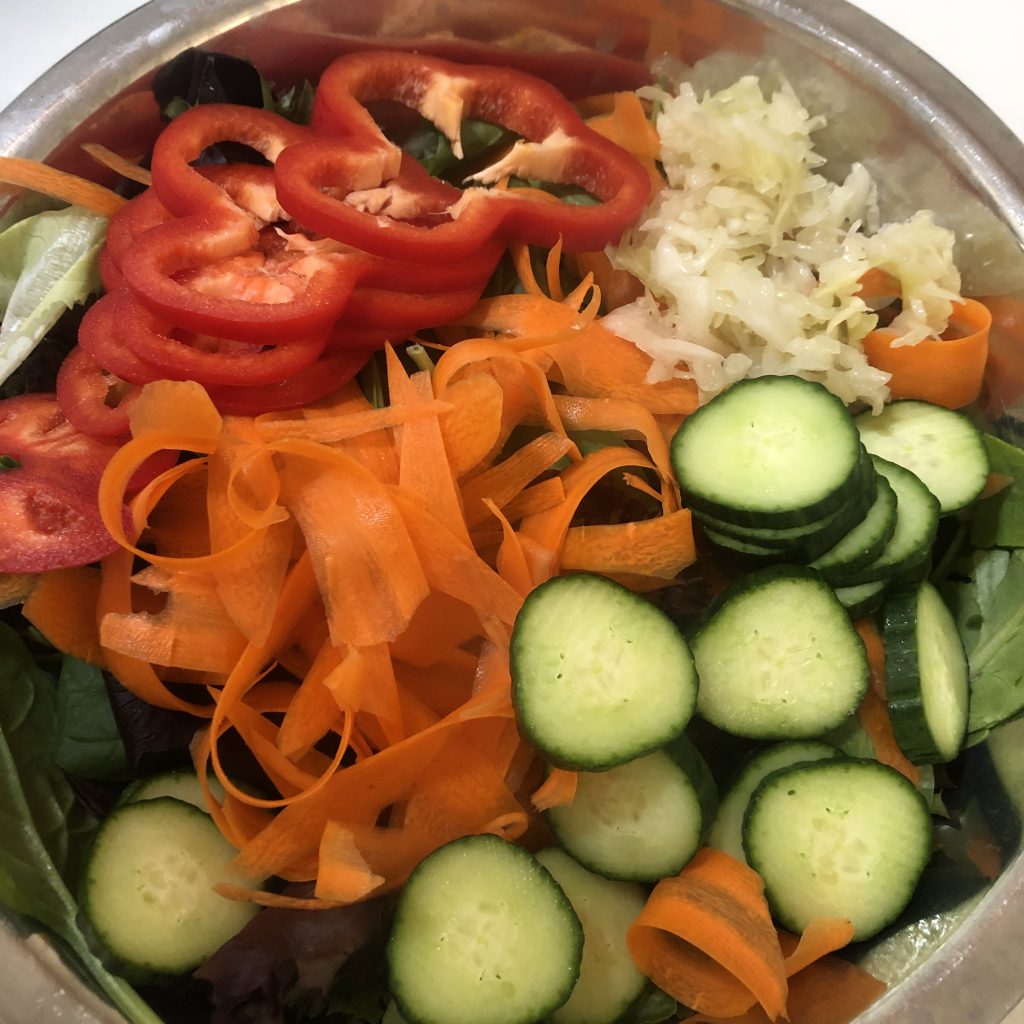
For tough veggies like carrots I tend to either shred them, or slice fine ribbons with a peeler. This is the same method I used for zoodles, which are a zucchini noodle, which is great with tomato sauce in place of pasta.
Yes to Seaweed
Sea veggies have always been a favorite of mine. They can be a salad in their own right. I’m not talking about the kind filled with sugar, and dyes. They are wonderful in soups, miso, but also in salads. I love hijiki marinated in a sweet Japanese soy dressing. Red Dulse is easy to rehydrate in minutes, and adds a salty savory boost, not to mention vitamins such as iodine. Toasted Nori is always delicious, by itself, or crumbled on top of salads.
Fermentation Station
Sauerkraut and Kimchi are a great addition to salads and dressings. They are not only tangy, but have a wide array of pre-biotics, which are beneficial for gut health. Unsweetened coconut yogurt also promotes gut health, and can also make a great base for a dressing.
Crunch Crunch
Adding a crunchy array of vegetables creates balance to a salad. Adding nuts, seeds, toasted coconut, and toasted garbanzo beans, will take your salad to another level. Some of my favorite crunchy salad toppings include sunflower seeds, cashews, thin sliced almonds, and pumpkin seeds.

Get Herbal
Nothing makes the flavor pop in a salad like fresh herbs. Some of my favorites, which you can infuse into a dressing, are dill, and basil. Feel free to sprinkle on a little cilantro for Mexican flair, or a bit of parsley, which complements just about anything.
Spice it Up
Everything from roast spicy peppers, or garlic, and ginger can be added into your salad. These are great in a dressing, or even grated on top for an extra kick. Try roasting garlic cloves, and add to your blender dressing recipe in place of fresh.
The Layered Salad
I like to begin assembling my salad by layering. Starting with the greens, working my way up to the crunchy finishing touches, such as sunflower seeds. Once everything is in the bowl, that’s when I start to improvise. I might take one more peek in the fridge, and check if there is something that belongs there.
A Not So Basic Salad
- 2-4 cups of chopped greens (kale, spring greens or romaine)
- ½ cup cucumbers
- 1 tomato chopped
- 1 carrot in thin strips
- ⅛ onions sliced thin
- ¼ cup shredded cabbage
- ¼ cup sauerkraut
- ¼ cup beans (chickpeas, lentils, or black beans)
- ½ cup cold cooked grains (rice, buckwheat, or quinoa)
- 1 tbsp crunchy topping (sunflower, pumpkin, or roast chickpeas)
- ¼ cup seaweed
- Leftover veggies (roast potatoes, broccoli, roast squash)
- 1 cup protein of your choice (about 4-6oz)
- Dressing of your choice
- 2 tbsp dried fruit (raisins, chopped apricots, or currants)
Simple or Complex
Salads can be super simple, or much more complex. A salad is something anyone can make, and make it their own. I just love to compose my own salads. Not only am I able to save a ton of money over buying them at the store, I get to make them my way. Not only that, I get to have fun creating my own recipe for health.
Be sure to Like and Subscribe to My Youtube Channel where I post videos!
Disclaimer: The work on this blog is my opinion and my opinion alone and I am not responsible for the outcome if someone were to apply these thoughts to their own life. All text and photography copyright 2020 by Serafina, all rights reserved. Information and opinions provided are kept current to the best of the author’s ability. All readers use of ideas and opinion presented in the blog, at their own risk. Be aware of the possible dangers of hiking, surfing, walking, cooking, and other activities, which may take place indoors or outdoors. By reading this, you agree not to hold the author or publisher of the content on this web site responsible for any injuries or inconveniences that may result from reading the blog, or partaking in any activity mentioned in the blog. Read the blog, and use it’s ideas, if you so desire, at your own risk.

 Serafina Hikes